
AI chatbot vs traditional chatbot: what’s the difference?
Both sit in the corner of a website and both are called chatbots. Under the hood they work completely differently, and visitors notice within one message.

For years, “chatbot” meant a traditional, rule-based chatbot: a decision tree dressed up as a conversation. You clicked “Prices”, then “Repairs”, then “Brakes”, and eventually reached a canned answer. An AI chatbot works the other way round. The visitor types whatever they want, and the bot works out what they mean and answers from your content.
The same message, two bots
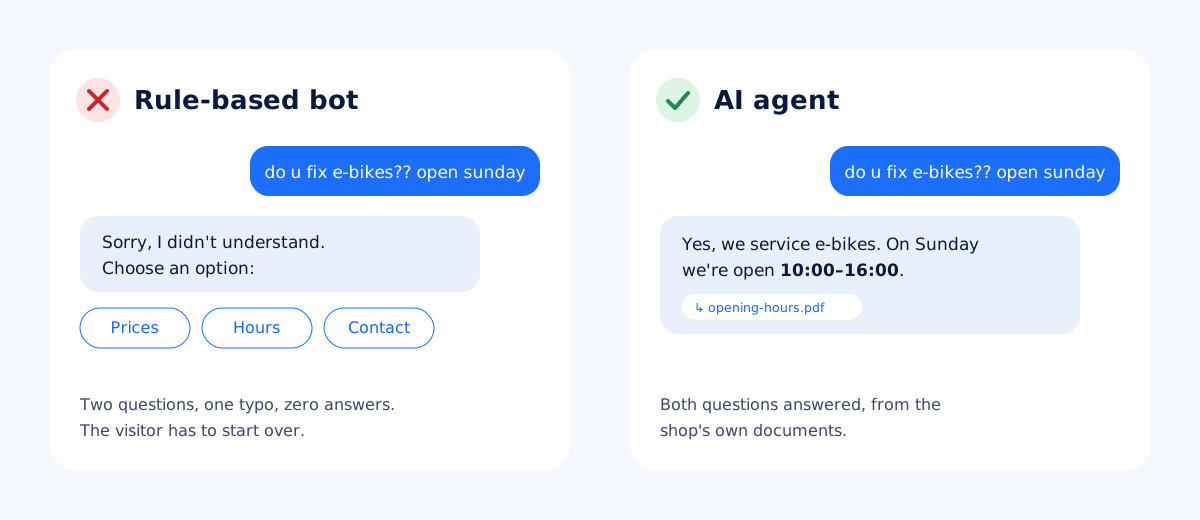
A rule-based bot matches keywords or waits for a button press. Typos, slang and two questions in one message fall through the cracks, and the visitor ends up back at the menu. An AI chatbot reads the whole message, finds the relevant passages in your documents, and answers both questions at once.
Side by side
| Traditional chatbot | AI chatbot | |
|---|---|---|
| How visitors ask | Buttons, menus, exact keywords | Any wording, typos included |
| Where answers come from | Replies you script one by one | Your documents and web pages |
| Setup | Design every flow and branch | Upload what you already have |
| Keeping it current | Edit each affected flow | Replace the document |
| Other languages | Build each flow again per language | Replies in the visitor's language |
| Unexpected questions | “Sorry, I didn't understand” | Answers if it's in your content, otherwise says so |
| Predictability | Says exactly what you scripted | Wording varies; facts come from your sources |
Where traditional chatbots still make sense
Scripts aren't all bad. A fixed flow is the right tool when every visitor must go through the same steps in the same order, such as a legally required questionnaire, or when the only job is routing (“Sales or support?”). In those cases predictability matters more than flexibility.
Where an AI chatbot wins
- Open questions. Most website visitors arrive with a specific question, not a wish to browse a menu.
- Lots of facts. A price list with 80 services would need 80 scripted branches. An AI chatbot just reads the list.
- Changing information. New prices? Upload the new file. Nothing to rebuild.
- Mixed-language audiences. One set of documents serves every language your visitors write in.
The catch, and how to handle it
The risk with AI chatbots is the one everyone has heard about: a general-purpose AI that fills gaps by guessing. The fix is to use a grounded AI chatbot, one that answers only from your sources and admits when it doesn't know. That's how askAgent is built, and it's why we think “I don't know” is a feature.
New to the idea? Start with What is an AI website agent?, then see how to add one to your website.


